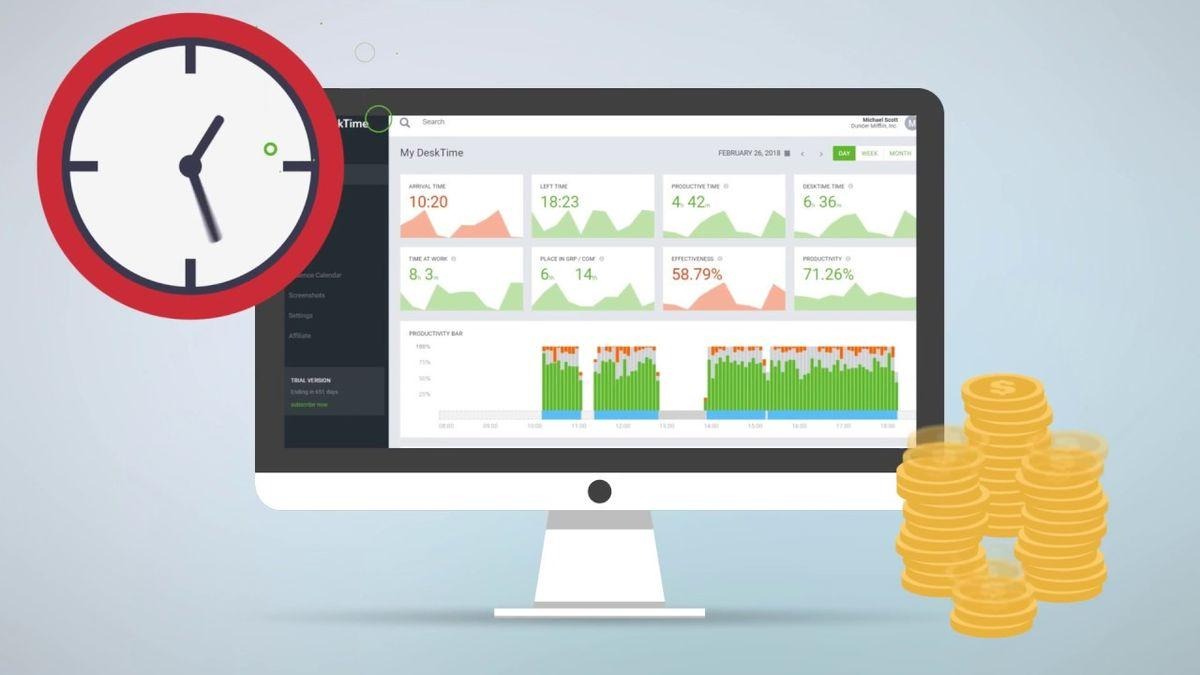
> For the complete documentation index, see [llms.txt](https://www.opentimeclock.com/docs/llms.txt). Markdown versions of documentation pages are available by appending `.md` to page URLs; this page is available as [Markdown](https://www.opentimeclock.com/docs/blog2/october-2025/employee-time-tracking-saas-tools-for-smarter-operations.md).
# Employee Time Tracking: SaaS Tools for Smarter Operations
Discover top SaaS employee time-tracking tools to optimize workflows, boost productivity, and simplify operations.
*Why does employee time tracking matter?*
Tracking the activities of your workforce is now a necessity in Modern Operations. Strategic decision making, operational cost control, efficiency, and compliance hinge on the recording of employee work time. Research abides by the fact that the migration from paper timesheets, spreadsheets, and punch clocks to a cloud-based solution is a game-changer.
For instance, one article highlights the importance of tracking time for "ensuring[ accurate timesheets](https://hubstaff.com/time-tracking/benefits-time-tracking-employees) and payroll, meeting legal and compliance standards, and saving businesses time and money."
Yet, there is much more to gain beyond the logging of basic work hours. Time tracking via cloud technology is fundamentally transforming the management and scaling of operations.
### **The rise of SaaS time tracking tools**
SaaS (Software as a Service) time tracking systems provide unique benefits that traditional, legacy systems cannot. These systems lack on-site hardware, provide mobile accessibility, real-time updates, and automation of payroll processes, HR functions, and project management.
In an Open Time Clock blog, the vendor claims that[ SaaS time tracking](https://www.opentimeclock.com/docs/blog2/october-2025/employee-time-tracking-how-saas-solutions-improve-accuracy-and-productivity-title) "boosts accuracy, enhances productivity, and simplifies workforce management for modern businesses."
Research on various digital technologies points out that organizations can optimize operations after adopting such tools because employee behaviour is measured and adjusted to create efficiency. As an example, a business study from Switzerland concluded that digital technologies cut the costs associated with monitoring employees and also improve incentive structures.
### **Key benefits of SaaS employee time tracking**
With that in mind, here are the main advantages of implementing a SaaS-based[ employee time tracking system](https://www.opentimeclock.com/docs/blog1/october-2025/10-ways-time-tracking-can-improve-employee-accountability):
#### **1. Accuracy and Payroll Integrity**
All systems can fail. In the case of manual systems, things like missed entries, rounding errors, and inconsistent application of rules (overtime, breaks) can wreak havoc. SaaS time tracking systems vastly improve this problem. For example, Open Time Clock's review mentions remote access and accurate, flexible overtime rule-sets as primary points.
#### **2. Productivity Insights and Operational Transparency**
SaaS time tracking is the modern approach to operational management. In the time-tracking guide, the author describes systems for identifying time wasters, such as meetings and redundant administrative tasks.
These insights improve managerial authority because decisions, such as resource allocation, bottleneck identification, and process changes, can be made based on data.
#### **3. Compliance with records and labor laws**
In many jurisdictions and industries, employers are required to document accurately breaks taken, hours worked, overtime, and other time tracking details. In order to fulfill these requirements, employers use clock-in systems.
Compared to paper logs, audit trails, rules that can be set and customized, and time-stamped records in a SaaS system provide a better compliance position.
#### **4. Flexibility in remote and hybrid working**
Time tracking SaaS services are designed for hybrid and remote teams because they offer mobile apps, web portals, and remote clocking in and out.
Evacuation remote control guarantees an operation is cohesive, whether your workers are in an office, on-site, or at home.
#### **5. Optimized decision making and resource planning**
Having time records means that you can better answer questions around what tasks are time-consuming, which projects provide profit, and what your staffing needs are.
Ties to operational, rather than just individual, time management are clear with employee time tracking.
### **Challenges and how SaaS helps overcome them**
SaaS flexibility and reliability provide the solution to the common time tracking challenges many businesses face.
These are some key pain points:
* Inefficiency and human error with manual systems: Drawers and spreadsheets for keeping track of time are inherently error-ridden.
* Employee engagement resistance: Employees fail to capture the intended purpose of time tracking and dismiss it as antagonistic micromanagement.
* Complexity with time data integration into payroll/HR systems: Silos stand in the way of utilization.
* Data integrity and security: Tracking time involves sensitive information that must be kept guarded, as one article rightly says.
* Adapting to changing workplace models: Hybrid, remote, and field work need flexible clocking systems, geolocation, and mobile support.
These problems can be mitigated with SaaS time tracking tools:
* Time tracking automates the clock-in and clock-out, breaks, and even overtime rule application. Open Time Clock illustrates how automation takes the hassle out of manual tracking.
* They interact with other systems so data flows in the correct order.
* Remote and field employees may use cloud access, which allows them to work without dependence on central hardware.
* Vendors pay attention to data security, encryption, and role-based access. The time tracking article mentions the need for security in modern systems.
### **A closer look: key features to evaluate**
When picking a SaaS for employee time tracking, some features are more important than others. This is what to look for:
1. No setup and ease of use: If your team is bogged down in setup or training, adoption suffers. In one Open Time Clock review, the simplicity of the system was praised, as it "allowed us to start focusing on our work instead of the software."
2. Cloud/mobile access: Employees can clock in or out over the web, through a mobile app, and even remotely.
3. Rule-based overtime and break handling: The system should support different custom policies for different groups or regions.
4. Reporting and dashboards: Turn raw hours into insights, like time spent on a project, team, or task.
5. Integrations: Payroll, HR systems, project management, and accounting.
6. Auditability and compliance logs: Time stamps, change logs, and exportable data for labour and audits.
7. Security/data protection: Encryption, role-based access, and privacy controls.
8. Adaptability: Shift work, field work, remote teams, and multiple locations.
### **What to avoid / pitfalls to watch**
The best tools will not yield results if you do not implement them correctly. Here are some things to avoid:
1. Using time tracking as pure surveillance: Time tracking is used solely as a means of surveillance. If employees feel that they are “watched”, rather than supported, they disengage. An article about time tracking highlighted that monitoring employees to the extent that it causes anxiety is unproductive.
2. Failing to integrate with other existing systems: When time data becomes siloed, reporting and workflows become more difficult.
3. Lack of policy calibration to your context: Having the same policy for breaks or overtime is unlikely to work for all teams/regions.
4. Lack of change management: New tools require communication, training, and buy-in.
5. Deficient analytics: Capturing hours and not analyzing is a missed opportunity.
6. Data security and privacy neglect: Time tracking involves sensitive employee data, so its misuse or breach will damage trust.
### **Conclusions**
Employee time tracking through SaaS tools has revolutionized how businesses manage productivity, attendance, and project efficiency. These cloud-based solutions provide real-time insights, automated reporting, and seamless integrations with payroll and HR systems.
By using smart time-tracking software, companies can reduce manual errors, enhance accountability, and gain valuable analytics for better decision-making. Whether for remote teams or on-site staff, SaaS tools streamline operations and ensure compliance with labor regulations. Investing in a reliable employee time-tracking system ultimately leads to higher efficiency, transparency, and overall business growth.
### **FAQs**
#### **1. What is SaaS time-tracking software?**
SaaS time-tracking software is a cloud-based tool that records employee work hours and attendance online.
#### **2. How does employee time tracking improve productivity?**
It helps monitor performance, manage schedules, and identify workflow inefficiencies.
#### **3. Can SaaS tools integrate with payroll systems?**
Yes, most modern time-tracking platforms integrate with payroll and HR software for automated processing.
#### **4. Are these tools suitable for remote teams?**
Absolutely, SaaS tools allow remote tracking through web and mobile apps.
#### **5. Is employee data secure in time-tracking systems?**
Yes, reputable SaaS providers use encryption and secure servers to protect employee data.
---
# Agent Instructions
This documentation is published with GitBook. GitBook is the documentation platform designed so that both humans and AI agents can read, navigate, and reason over technical content effectively. Learn more at gitbook.com.
## Querying This Documentation
If you need additional information that is not directly available in this page, you can query the documentation by asking a question.
Perform an HTTP GET request on the following URL with the `ask` and `goal` query parameters:
```
GET https://www.opentimeclock.com/docs/blog2/october-2025/employee-time-tracking-saas-tools-for-smarter-operations.md?ask=&goal=
```
`ask` is the immediate question: it should be specific, self-contained, and written in natural language.
`goal` is what the user is ultimately trying to achieve, the reason they need the answer. Sharing it helps GitBook give you a better, more relevant answer. A goal is most helpful when it describes the outcome the user wants rather than restating the question. For example, with `ask=how do I create an API token`, a goal like `automate deployments from our CI pipeline` lets GitBook tailor the answer to that use case.
The response will contain a direct answer to the question and relevant excerpts and sources from the documentation.
Use this mechanism when the answer is not explicitly present in the current page, you need clarification or additional context, or you want to retrieve related documentation sections.