> For the complete documentation index, see [llms.txt](https://www.opentimeclock.com/docs/llms.txt). Markdown versions of documentation pages are available by appending `.md` to page URLs; this page is available as [Markdown](https://www.opentimeclock.com/docs/message.md).
# Message
Message allows administrators and managers to send announcements or private messages directly to employees within the system.
It’s used for quick communication about schedules, updates, or important notices without needing external email or chat tools.
***
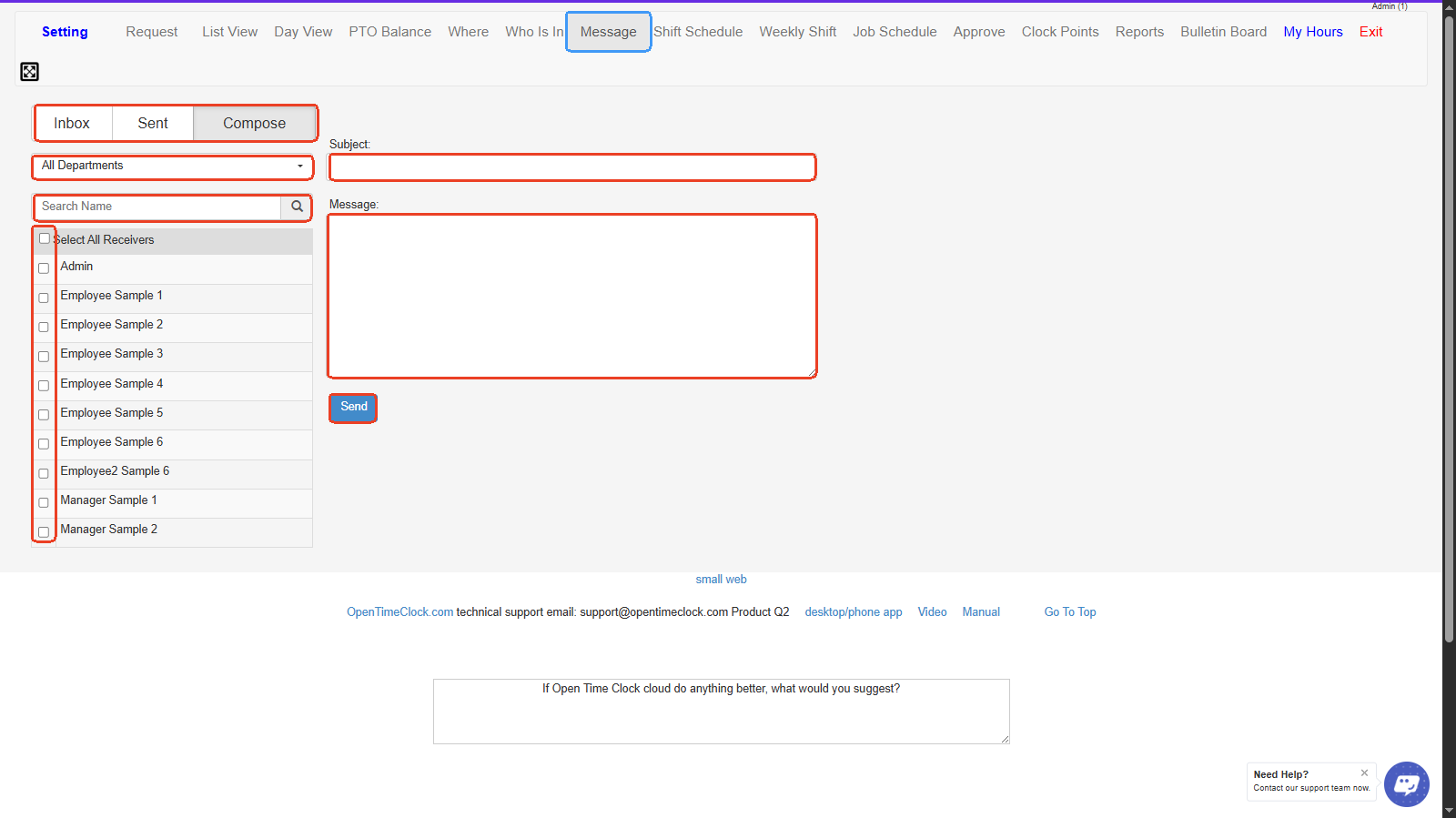
1. **Inbox / Sent / Compose Tabs**
* **Inbox**: View messages received from employees or managers.
* **Sent**: View messages you’ve sent.
* **Compose**: Create and send a new message.
2. **Department Filter-** Dropdown to filter employees by department to narrow down message recipients.
3. **Search Name-** Search box to quickly find a specific employee to message.
4. **Receiver List-** List of employees you can select as recipients; includes “Select All Receivers” for bulk messaging.
5. **Subject Field-** Enter the title or topic of your message here.
6. **Message Body-** Type the main content of your message here.
7. **Send Button-** Click to send the composed message to the selected recipients.
***
Feel free to contact us at our toll-free number: +1-833-702-2927 or email us at support@opentimeclock.com.
---
# Agent Instructions
This documentation is published with GitBook. GitBook is the documentation platform designed so that both humans and AI agents can read, navigate, and reason over technical content effectively. Learn more at gitbook.com.
## Querying This Documentation
If you need additional information that is not directly available in this page, you can query the documentation dynamically by asking a question.
Perform an HTTP GET request on the current page URL with the `ask` query parameter, and the optional `goal` query parameter:
```
GET https://www.opentimeclock.com/docs/message.md?ask=&goal=
```
`ask` is the immediate question: it should be specific, self-contained, and written in natural language.
`goal` is optional and describes the broader end goal you are ultimately trying to accomplish on behalf of the user. GitBook uses it to tailor the answer towards what is most useful for that goal.
The response will contain a direct answer to the question and relevant excerpts and sources from the documentation.
Use this mechanism when the answer is not explicitly present in the current page, you need clarification or additional context, or you want to retrieve related documentation sections.