Shiftboard vs Deputy: Which Handles Complex Scheduling Better?
Compare Shiftboard vs Deputy for complex employee scheduling and time tracking. See features, costs, and why OpenTimeClock is the best free alternative today.
When businesses with large, complex workforces start evaluating scheduling software, Shiftboard vs Deputy frequently emerges as a key comparison. Both platforms have built strong reputations for handling the kind of scheduling complexity that basic tools cannot manage. Both are marketed toward businesses that need more than a simple shift calendar and offer sophisticated features for demand-driven scheduling, compliance management, and workforce optimization.
But complexity in software often comes with complexity in pricing, complexity in implementation, and features that many businesses pay for but never actually use. Understanding the Shiftboard vs Deputy comparison carefully helps businesses determine whether either platform is the right fit or whether a simpler, free alternative covers their actual needs more efficiently.
This article gives you a complete breakdown of Shiftboard vs Deputy across scheduling depth, time tracking, compliance, pricing, and ease of use, and introduces OpenTimeClock as the free alternative that many businesses should evaluate before committing to either paid platform.
What Shiftboard Is and Who It Serves
Shiftboard is an enterprise-focused workforce scheduling platform designed for organizations with complex staffing requirements. It serves industries including healthcare, manufacturing, security, energy, and government contracting, where scheduling involves multiple skill sets, certification requirements, shift rotation rules, and compliance obligations.
The platform's scheduling engine is built around demand-driven staffing, matching the right workers to the right shifts based on skills, certifications, availability, and labor rules. For organizations managing hundreds of workers across multiple shifts and locations with specific qualification requirements for each position, Shiftboard provides the sophisticated matching and rule enforcement that simpler tools cannot handle.
Shiftboard also includes shift bidding and open shift management, allowing workers to express preferences and bid for available shifts within defined rules. Time and attendance tracking, overtime management, and payroll integration are included. The platform supports complex union rule enforcement, which is important for organizations with collective bargaining agreements.
Pricing. Shiftboard is an enterprise platform and pricing is negotiated rather than publicly listed. Based on user reports and industry analysis, Shiftboard is positioned at the higher end of the workforce management market with annual contract pricing that reflects its enterprise focus. It is generally not cost-effective for small businesses or teams with straightforward scheduling needs.
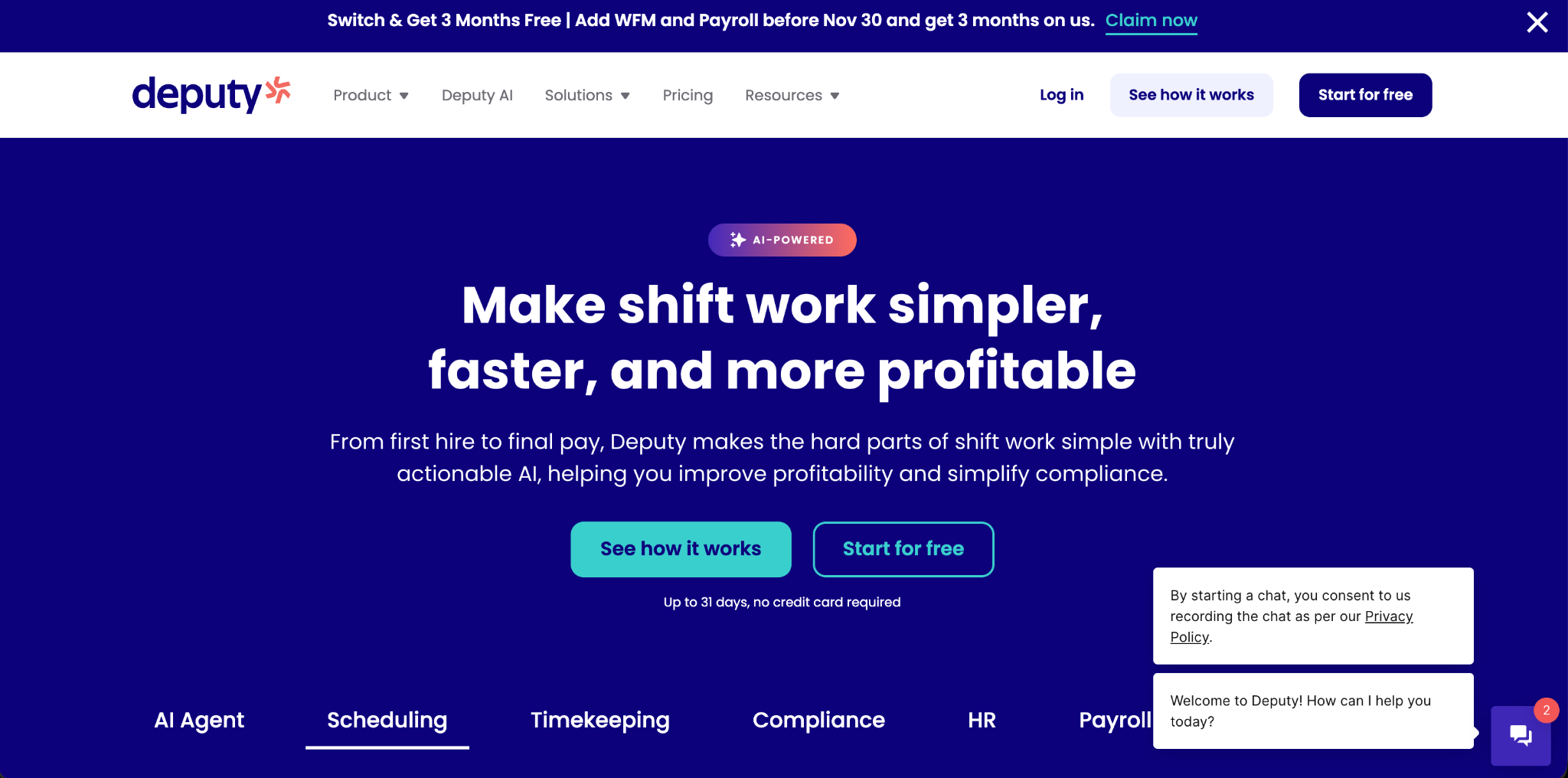
What Deputy Is and Who It Serves
Deputy is an Australian-founded workforce management platform that has expanded significantly into the US, UK, and European markets. It targets small to mid-market businesses across retail, hospitality, healthcare, and logistics with a strong emphasis on making scheduling fast and accessible for non-technical managers.
Deputy's scheduling interface is modern and intuitive. The AI-assisted scheduling feature suggests optimal shift assignments based on employee availability, skills, and labor cost targets. Managers can publish schedules, handle shift swaps, and communicate with their team through the Deputy app. The platform also includes time and attendance tracking, leave management, and payroll integrations with major providers.
Deputy's compliance features help businesses adhere to labor laws around scheduling, breaks, and overtime in the jurisdictions where they operate. This is particularly valuable for businesses operating in multiple states or countries with different labor regulations.
Pricing. Deputy offers a scheduling-only plan at around three to four dollars per user per month, and a more comprehensive plan that includes time and attendance at around four to five dollars per user per month. An enterprise tier with additional features is available at custom pricing. For a team of thirty employees on the full plan, costs reach approximately one hundred and fifty dollars per month.
Head-to-Head: Shiftboard vs Deputy Feature Comparison
When comparing Shiftboard vs Deputy directly on the features that matter most for complex scheduling and workforce management, here is how they measure up.
Scheduling complexity. Shiftboard leads by a significant margin for genuinely complex scheduling environments. Its skill matching, certification tracking, union rule enforcement, and demand-driven scheduling engine handle the kind of complexity that Deputy's interface cannot replicate. For healthcare staffing agencies, security firms, or manufacturing plants with multiple skill tiers and strict qualification requirements, Shiftboard is the more capable tool.
Ease of use. Deputy leads on ease of use. Its interface is modern, intuitive, and accessible to managers without technical expertise. Shiftboard's complexity comes with a corresponding learning curve. For businesses where managers need to build and publish schedules quickly without specialized training, Deputy's accessibility is a meaningful advantage.
Time tracking verification. Neither platform provides the depth of biometric verification that dedicated time clock platforms offer. Deputy includes a time clock with photo capture and GPS. Shiftboard includes time and attendance tracking with various clock-in options. Both are functional but neither provides facial recognition without additional hardware, and neither creates the visual audit trail depth that dedicated verification-focused platforms deliver.
Mobile experience. Deputy's mobile app is well-regarded and widely used by employees for schedule viewing, shift swap requests, and clock-in. Shiftboard's mobile functionality is more limited and better suited to the desktop-focused management environment it was designed for.
Compliance features. Both platforms include compliance tools. Shiftboard's compliance features are more sophisticated for complex environments involving union contracts and strict regulatory requirements. Deputy's compliance features are adequate for most small to mid-market businesses dealing with standard labor law requirements.
Cost. Shiftboard is significantly more expensive than Deputy. Deputy is more affordable but still represents a meaningful ongoing subscription cost, particularly for larger teams.
Where Both Platforms Fall Short on Time Tracking
The Shiftboard vs Deputy comparison highlights a gap that both platforms share: neither provides the level of verified time tracking that prevents time fraud and creates defensible attendance records as a standard feature without dedicated hardware investment.
Shiftboard's time tracking is functional but secondary to scheduling as its core value proposition. Deputy's time tracking includes photo capture and GPS, which is better than Shiftboard's standard offering, but facial recognition and the depth of verification that creates truly reliable attendance records requires additional configuration or hardware.
For businesses where the primary operational concern is ensuring accurate, fraud-resistant time records, and where scheduling complexity is secondary or moderate rather than enterprise-grade, both platforms leave something to be desired on the time tracking side.
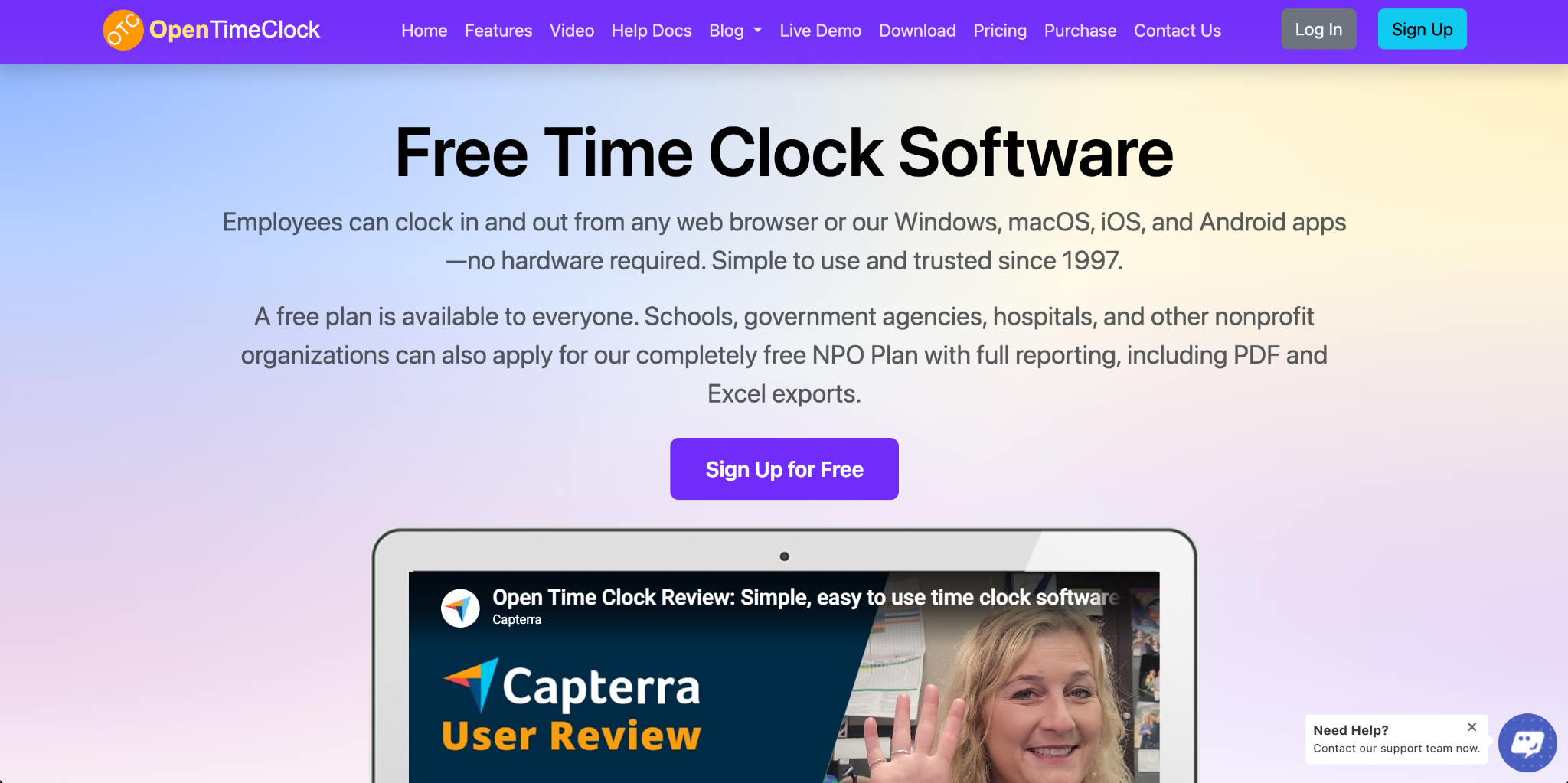
OpenTimeClock: Better Time Tracking at Zero Cost
Many businesses that search for Shiftboard vs Deputy comparisons are actually looking for a platform that provides reliable time tracking alongside functional scheduling. Once they discover what each platform actually costs and what level of scheduling complexity they genuinely need, the case for a simpler, free alternative becomes clear.
OpenTimeClock provides facial recognition clock-in using any device camera, photo capture at every clock event, GPS location recording for mobile clock-in, PIN and QR code as alternative methods, real-time attendance dashboard, automated overtime alerts, functional shift scheduling, PTO management, and payroll exports in multiple formats. All of this is completely free with no per-user fees and no subscription required.
For businesses that need reliable, verified time tracking with functional scheduling, the value that OpenTimeClock delivers for free exceeds what most businesses actually use from either Shiftboard or Deputy's paid plans.
Who Actually Needs Shiftboard-Level Scheduling Complexity
Being honest about the Shiftboard vs Deputy comparison requires acknowledging that most businesses do not actually need Shiftboard-level scheduling complexity.
Shiftboard is purpose-built for organizations managing hundreds of workers across multiple skill tiers, certification requirements, and complex union or regulatory constraints. A healthcare staffing agency managing nurses with specific certifications across multiple hospital facilities genuinely benefits from Shiftboard's matching engine. A manufacturing plant running continuous operations with multiple union job classifications genuinely needs Shiftboard's rule enforcement.
A restaurant with thirty employees, a retail store with twenty-five staff, a logistics company with fifty drivers, or a professional services firm with forty consultants does not need this level of scheduling sophistication. These businesses need functional scheduling that is easy to build and publish, connected to reliable time tracking. The scheduling component of OpenTimeClock covers these needs adequately at zero cost.
Who Actually Needs Deputy-Level Scheduling Features
Deputy occupies the middle ground in the Shiftboard vs Deputy comparison, offering more scheduling sophistication than basic tools but without the enterprise complexity of Shiftboard.
Deputy makes the most sense for businesses where AI-assisted scheduling, demand-based staffing optimization, and sophisticated employee availability management are daily operational needs, and where the per-user subscription cost is a justified investment in scheduling efficiency.
For businesses where managers build schedules manually based on their knowledge of their team and their operations, Deputy's AI features add cost without delivering proportional value. The drag-and-drop scheduling interfaces that both Deputy and simpler tools provide are adequate for most scheduling tasks.
Scheduling in OpenTimeClock for Moderate Complexity
OpenTimeClock's shift scheduling feature supports the scheduling needs of most small to mid-size businesses. Managers create shifts with defined start and end times, assign employees, configure clock-in window restrictions, and publish schedules that employees can view from any device. Reusable weekly templates reduce the time required to build recurring schedules. Automated alerts notify managers when scheduled employees do not clock in on time.
For businesses with straightforward scheduling patterns, even with multiple shifts and locations, this functionality is fully adequate. The scheduling connects directly to the time tracking so that planned shifts and actual attendance are visible in the same system, eliminating the disconnection between a scheduling tool and a separate time clock that many businesses manage.
Total Cost Comparison Over Three Years
The cost comparison in the Shiftboard vs Deputy context becomes even more significant when projected over a realistic time horizon.
Shiftboard's enterprise pricing is negotiated but typically represents thousands of dollars annually for most implementations.
Deputy at four dollars per user per month for thirty employees costs one hundred and twenty dollars per month, or four thousand three hundred dollars over three years.
OpenTimeClock costs zero dollars over three years, regardless of team size or number of locations.
For the majority of businesses comparing Shiftboard vs Deputy because they want better workforce management, the three-year cost difference between either paid platform and a free alternative that covers their actual needs is the single most persuasive argument for evaluating OpenTimeClock before committing to a subscription.
Conclusion
Shiftboard vs Deputy is a comparison between two legitimate workforce management platforms with genuine strengths in different areas. Shiftboard leads for enterprise-grade scheduling complexity. Deputy leads for accessible, modern scheduling for mid-market businesses. Neither is free, and neither provides the time tracking verification depth of a dedicated clock platform.
For the majority of small and medium businesses, OpenTimeClock delivers verified time tracking, functional scheduling, PTO management, overtime control, and payroll exports at zero cost, outperforming both platforms on value for the use cases most businesses actually have. Sign up for free at OpenTimeClock and have your scheduling and time tracking running from your very next shift.
FAQ’s
Q1. What is the main difference between Shiftboard vs Deputy?
In the Shiftboard vs Deputy comparison, Shiftboard is an enterprise-focused platform for organizations with complex scheduling requirements including skill matching, certification tracking, and union rule enforcement. Deputy is a more accessible mid-market platform with AI-assisted scheduling and a modern interface for businesses with moderate scheduling complexity. OpenTimeClock provides functional scheduling and superior time tracking verification at zero cost.
Q2. Which businesses truly need Shiftboard-level scheduling complexity?
Shiftboard is genuinely necessary for organizations managing large workforces with specific skill and certification requirements, complex shift rotation rules, and union contract compliance obligations, such as healthcare staffing agencies, large security firms, or manufacturing plants with multiple job classifications.
Q3. Does OpenTimeClock provide better time tracking than Shiftboard vs Deputy?
Yes for most businesses. OpenTimeClock provides facial recognition using any device camera, photo capture at every clock event, and GPS recording as standard free features. In the Shiftboard vs Deputy comparison, neither platform provides this level of biometric verification without additional hardware or configuration.
Q4. What scheduling features does OpenTimeClock provide for moderate-complexity businesses?
OpenTimeClock's shift scheduling feature covers shift creation, employee assignment, clock-in window restrictions, reusable weekly templates, digital schedule publishing for employee self-service viewing, and automated alerts when employees miss scheduled clock-ins.
Q5. How does the cost of OpenTimeClock compare to Shiftboard vs Deputy?
Shiftboard uses negotiated enterprise pricing that typically represents thousands of dollars annually. Deputy costs approximately four dollars per user per month, representing over four thousand dollars over three years for a thirty-person team. OpenTimeClock is completely free with no credit card required, no per-user fees, and no subscription cost.