OpenTimeClock vs Time Doctor: Which Fits Teams That Track Hours?
Compare OpenTimeClock and Time Doctor on pricing, clock-in methods, employee monitoring, and payroll reports to choose the right fit.
Every team that pays by the hour needs a reliable way to track time. But "tracking time" can mean very different things. For a retail store or a school, it means knowing when employees clock in and out. For a remote team of developers or virtual assistants, it may mean seeing how time is spent on the computer throughout the day.
OpenTimeClock and Time Doctor are two popular tools that approach time tracking from these two different angles. OpenTimeClock is an employee time clock focused on attendance and payroll-ready hours, with a free plan and flat company pricing. Time Doctor is a time tracking and productivity monitoring tool built mainly for remote and computer-based teams.
In this guide, we will compare OpenTimeClock vs Time Doctor in simple terms. We will look at pricing, how employees track time, monitoring features, attendance controls, payroll reporting, privacy considerations, and which type of team each tool fits best.
Quick Overview of OpenTimeClock
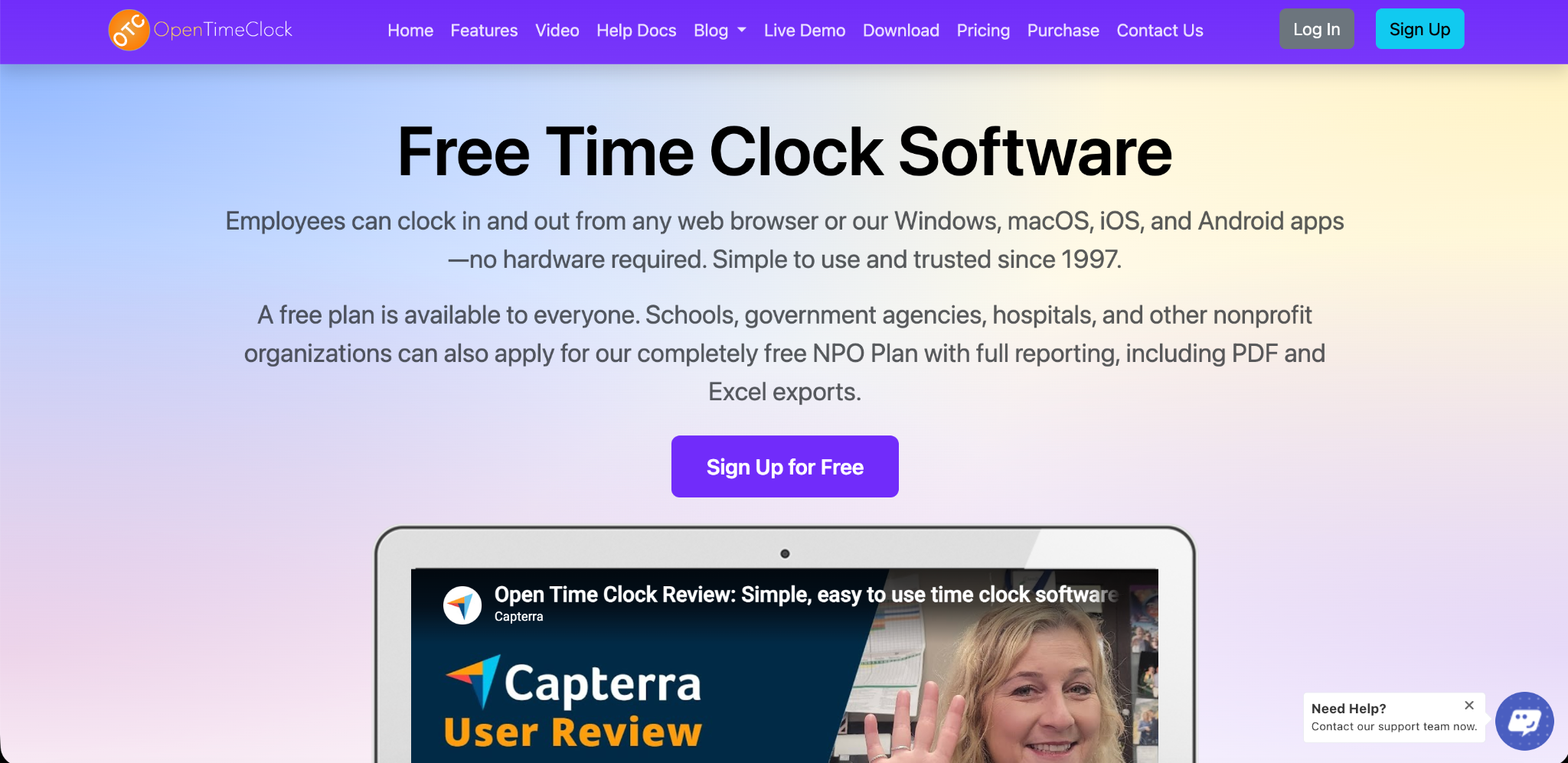
OpenTimeClock is a cloud-based time clock and attendance system that has been in business since 1997. Employees can clock in and out from web browsers and from apps for Windows, macOS, iOS, and Android. Any tablet can be turned into a wall-mounted or desktop time clock.
It offers many clock-in methods, location controls, scheduling, overtime rules, paid time off tracking, manager approvals, project and job tracking, and more than 80 ready-made reports.
OpenTimeClock offers a free plan with unlimited users, a paid plan priced per company, and free plans for nonprofits and other eligible organizations.
Quick Overview of Time Doctor
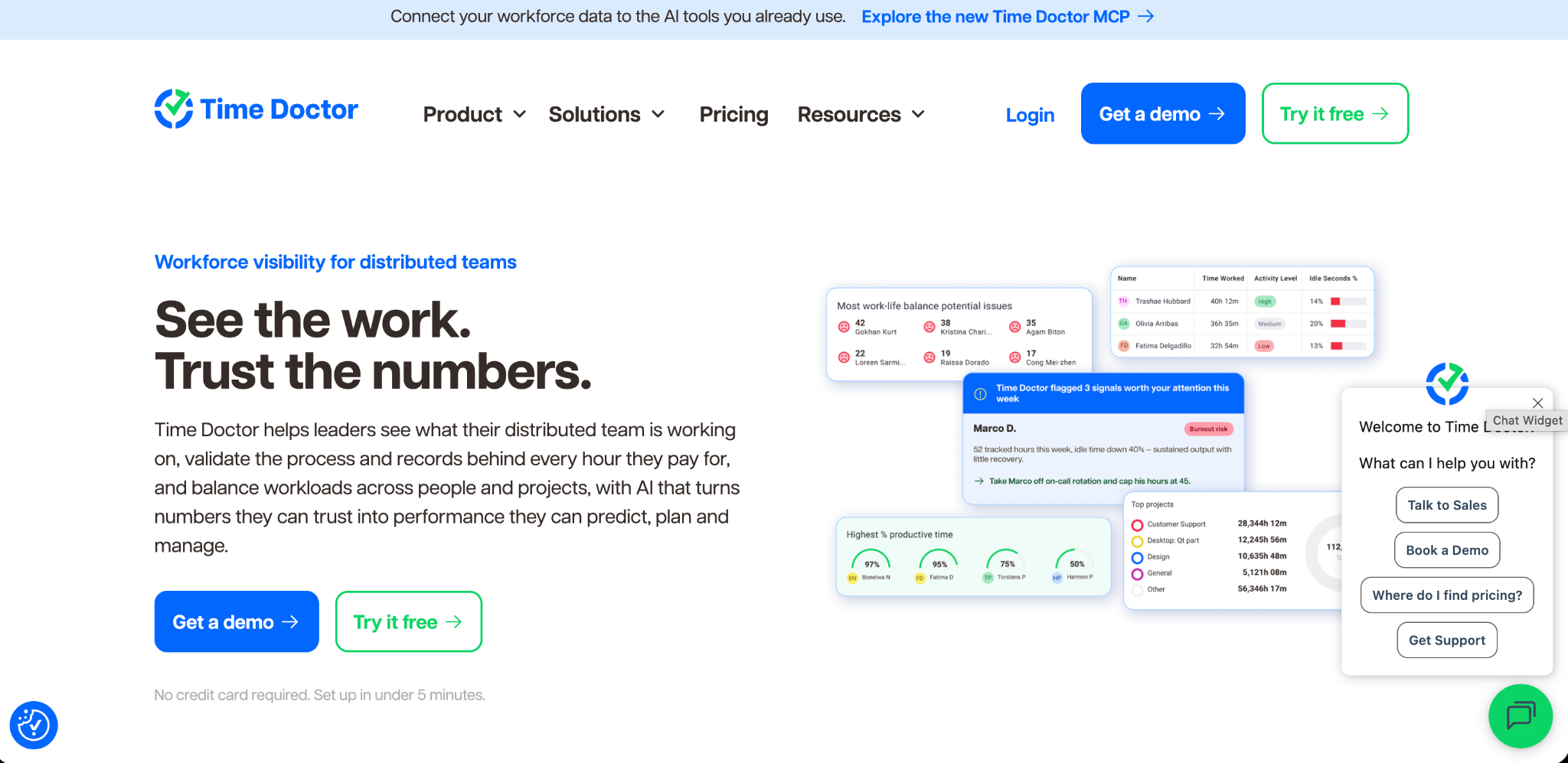
Time Doctor is a time tracking and employee productivity platform designed mainly for remote, hybrid, and office teams that work on computers. Employees track time on tasks and projects using a desktop app, and the system records computer activity during tracked time.
Time Doctor offers features such as task tracking, activity and productivity reports, app and website usage tracking, screenshots, idle time detection, payroll tools on higher plans, and integrations with many work apps. Some plans also include video screen recording.
The Key Difference
The simplest way to understand OpenTimeClock vs Time Doctor is to look at what each tool measures.
OpenTimeClock measures attendance. It answers the question, "When did each employee start and stop work, and were they in the right place?" It is built for hourly and shift-based teams that need accurate hours for payroll.
Time Doctor measures computer work and productivity. It answers the question, "How was time spent on the computer during work hours?" It is built for teams that work at computers and want detailed activity insights.
Pricing Comparison
OpenTimeClock Pricing
The Free Plan costs nothing and includes unlimited users and free support. It includes full features except downloading reports in PDF and Excel formats, which is available free for the first 30 days.
The Paid Plan costs $39 per month or $399 per year per company, with unlimited users. The price stays the same whether you have 5 employees or 500.
The NPO Plan offers free access to paid features for schools, government agencies, hospitals, and other nonprofits that apply. There is also a Sponsor Link Plan that gives free access to paid features in exchange for a text link on your website.
You can see full details on the OpenTimeClock pricing page.
Time Doctor Pricing
Time Doctor uses per-user pricing. Based on recent pricing checks, the Basic plan costs about $6.70 per user per month when billed annually, or about $8 when billed monthly. The Standard plan costs about $11.70 per user per month annually, and the Premium plan about $16.70 per user per month annually. Monthly billing costs more. An Enterprise plan with custom pricing is also available.
Payroll features and most integrations start at the Standard plan. Some Premium features can be added to lower plans as paid add-ons. Time Doctor offers a free trial but no permanent free plan.
Cost Example
Let us look at a team of 25 people.
On Time Doctor's Basic plan billed annually, the cost would be about $167 per month. On the Standard plan, it would be about $292 per month.
On OpenTimeClock's Paid Plan billed yearly, the cost would be about $33 per month, no matter how many users there are. The Free Plan could cost nothing at all.
For large hourly teams, OpenTimeClock is usually much cheaper. Teams that need detailed computer activity monitoring may find Time Doctor's features worth the higher cost.
How Employees Track Time
OpenTimeClock
Employees clock in and out using one of many methods, including username and password, PIN code, QR code or barcode, RFID or NFC cards, name selection, facial recognition, or group clock-in by managers. They can also switch between jobs and departments during a shift. A PIN code time clock is one of the fastest options for shared kiosks.
This works well for employees who do not sit at a computer all day, such as retail staff, warehouse workers, healthcare staff, and school employees.
Time Doctor
Employees usually install a desktop app on their work computer and start tracking time on a task. The app records time and computer activity until the employee stops tracking or goes idle. There are also options for manual time entry and mobile use.
This works best for employees who spend most of their day working on a computer, such as developers, designers, support agents, and virtual assistants.
Which Is Better?
If your team works on the floor, in the field, or at shared stations, OpenTimeClock fits more naturally. If your team works mainly on computers and you want activity data, Time Doctor is designed for that.
Monitoring and Productivity Features
This is where the two tools differ the most.
Time Doctor offers detailed monitoring features, such as tracking which apps and websites are used, activity levels, idle time, screenshots, and on some plans, video screen recording. It also provides productivity reports that show how time is spent.
OpenTimeClock does not focus on monitoring computer activity. Instead, it confirms attendance and identity through clock-in controls, such as photo capture, facial recognition, and location rules.
For businesses that want insight into remote computer work, Time Doctor offers much more. For businesses that simply want accurate hours without monitoring screens, OpenTimeClock keeps things simpler.
Attendance and Location Controls
OpenTimeClock includes strong tools to confirm attendance. Photo capture and facial recognition help prevent buddy punching, and clock points let employers limit clock-ins to approved GPS locations, WiFi networks, IP addresses, or devices. Managers can see who is working in real time and receive notifications for late arrivals, early departures, and overtime limits.
Time Doctor tracks attendance mainly through when employees start and stop tracking on their computers. It offers attendance reports and alerts, but it is not built around physical clock-in stations or on-site location checks in the same way.
For teams that need to prove employees were physically at work, OpenTimeClock offers more attendance controls.
Overtime and Payroll Reporting
OpenTimeClock
OpenTimeClock is built with payroll in mind. Overtime management applies daily and weekly overtime rules automatically, and payroll and attendance reports show regular hours, overtime, and paid time off. Reports can be exported in PDF, Excel, CSV, and other formats on eligible plans. Managers can approve hours and lock old records before payroll.
Time Doctor
Time Doctor offers payroll features on its Standard plan and above, including pay rates and payroll reports, and integrations with payment and payroll tools. It is especially used by companies that pay remote contractors and freelancers based on tracked time.
Which Is Better?
For hourly employees with overtime rules, shifts, and paid time off, OpenTimeClock is designed around these needs. For remote teams and contractors paid based on computer-tracked time, Time Doctor's payroll tools may fit better.
Privacy and Employee Trust
Monitoring tools can raise privacy concerns. Screenshots, app tracking, and screen recording give managers detailed insight, but some employees may feel uncomfortable being watched closely.
If you choose a monitoring tool, be open with employees about what is tracked and why, track only during work time, and follow local privacy laws. Some regions have rules about notice and consent for electronic monitoring.
OpenTimeClock collects less activity data by design. It focuses on clock-in times, locations at clock-in, and identity checks, which may feel less intrusive for many teams.
Scheduling and Time Off
OpenTimeClock includes shift scheduling, job schedules, paid time off tracking with automatic accruals, absence management, and manager approval of time off requests.
Time Doctor includes some attendance scheduling and time off features, depending on the plan.
For shift-based teams that need detailed scheduling and leave tracking, OpenTimeClock offers more built-in tools.
Integrations
Time Doctor offers many integrations with project management, help desk, CRM, and communication tools on its Standard plan and above, so time can be tracked inside apps teams already use.
OpenTimeClock offers exportable reports, website embedding, and a developer API on paid plans for businesses that want to connect data to other systems.
For computer-based teams using many work apps, Time Doctor has the advantage.
Pros and Cons Summary
OpenTimeClock Strengths
A free plan with unlimited users. Flat company pricing that does not grow with team size. Many clock-in methods for shared stations and field work. Strong attendance, location, and buddy punching controls. Overtime rules, scheduling, paid time off, and approvals. Less intrusive for employees.
OpenTimeClock Limitations
No computer activity monitoring. Fewer integrations with work apps. Not designed for paying remote contractors based on tracked screen time.
Time Doctor Strengths
Detailed computer activity and productivity tracking. Screenshots and optional screen recording. Many integrations with work apps. Payroll tools for remote teams and contractors.
Time Doctor Limitations
Per-user pricing that grows with team size. No permanent free plan. Payroll and integrations require higher plans. Monitoring features may raise privacy concerns. Less suited to shift workers who do not use computers.
Which Should You Choose?
The right choice in OpenTimeClock vs Time Doctor depends on how your team works.
Choose OpenTimeClock If
Your team is mostly hourly or shift-based. Employees clock in at shared stations, job sites, or kiosks. You need attendance controls, location checks, and buddy punching prevention. You want accurate hours for payroll with overtime and paid time off. You want a free option or flat pricing for a large team. You prefer not to monitor employee screens.
Choose Time Doctor If
Your team works mainly on computers, often remotely. You want detailed activity and productivity reports. You pay remote contractors based on tracked time. You want time tracking inside many work apps.

Conclusion
OpenTimeClock and Time Doctor both help teams track hours, but they are built for very different needs. OpenTimeClock is an employee time clock focused on attendance, shifts, overtime, and payroll, with many clock-in methods, strong location controls, a free plan, and flat company pricing. Time Doctor is a productivity and monitoring tool focused on computer-based work, with activity tracking, screenshots, integrations, and per-user pricing.
When comparing OpenTimeClock vs Time Doctor, start by asking what you really need to measure. If you need accurate attendance and payroll-ready hours for hourly staff, OpenTimeClock is a strong and affordable choice. If you need to understand how remote computer work is done, Time Doctor is built for that job. Understanding OpenTimeClock vs Time Doctor this way helps you choose the tool that fits your team, your budget, and your workplace culture.
FAQ’s
What is the main difference between OpenTimeClock and Time Doctor?
OpenTimeClock is an employee time clock for attendance and payroll. Time Doctor is a time tracking and productivity monitoring tool for computer-based work.
Is OpenTimeClock free?
Yes. OpenTimeClock offers a Free Plan with unlimited users and full features except PDF and Excel report downloads, which are free for the first 30 days.
How much does Time Doctor cost?
As of October 2026, Time Doctor plans start at about $6.70 per user per month on the Basic plan with annual billing. Standard and Premium plans cost more.
Does the Time Doctor take screenshots?
Yes. Time Doctor can capture screenshots and track apps and websites used during work time. Some plans also include screen recording.
Which is better for retail or warehouse teams?
OpenTimeClock is usually a better fit because it offers kiosks, PIN codes, card readers, facial recognition, overtime rules, and attendance controls for shift workers.