OpenTimeClock vs Factorial: Comparing Time Tracking, Reporting, and Employee Management
Compare OpenTimeClock vs Factorial on time tracking, reporting, and employee management features. Find out which platform gives your business more value today.
When businesses look for an all-in-one platform to manage employee time, reporting, and HR functions, Factorial often appears alongside more established names in the workforce management space. It has built a reputation as a modern HR platform designed for small and medium businesses, with a clean interface and a broad feature set that covers everything from time tracking to document management and performance reviews.
But broad feature sets come with trade-offs. Platforms that try to do everything sometimes do individual things less well than specialized tools. And they almost always come with a price tag that reflects the full scope of what they offer, whether or not a specific business needs every module.
This article compares OpenTimeClock vs Factorial directly across the features that matter most for time tracking, reporting, and employee management, and explains which types of businesses are best served by each platform.
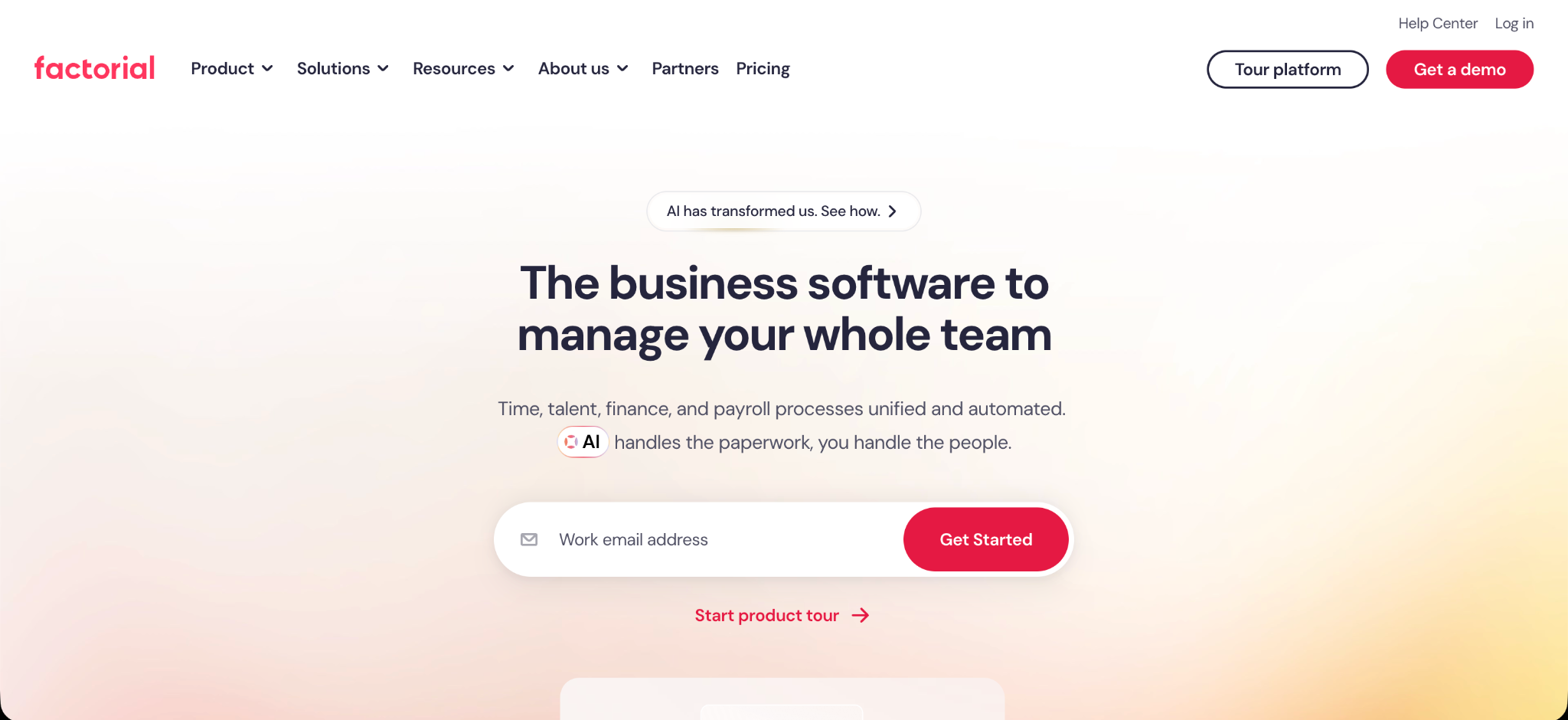
What Factorial Is and What It Focuses On
Factorial is an HR software platform founded in Spain that has grown significantly in the European market and expanded internationally. It positions itself as a complete HR operating system for small and medium businesses, covering time tracking, shift scheduling, PTO management, document management, performance reviews, expense management, payroll in some markets, and recruitment tools.
The platform is built around the idea that small businesses should have access to the same kind of integrated HR tooling that large enterprises use, without needing a dedicated HR department to operate it. Its interface is modern and visually clean, and the breadth of its feature set is genuinely impressive for the market it targets.
Factorial's time tracking module allows employees to clock in through a web browser, a mobile app, or a physical terminal. The module includes basic GPS tracking, overtime calculation, and shift scheduling. Reports covering attendance, overtime, and absence are available within the platform.
Pricing. Factorial's pricing varies by market and plan. The platform operates on a per-employee per-month model. In markets where pricing is publicly listed, plans typically start at around five dollars per employee per month for the basic tier and rise significantly for plans that include more advanced features like payroll processing, performance management, and recruitment tools. For a team of twenty employees, the monthly cost on even a mid-tier plan can reach one hundred to two hundred dollars or more.
Limitations. For businesses that primarily need time and attendance management rather than the full HR suite, Factorial may be significantly more platform and cost more than is necessary. The time tracking module, while functional, is not the platform's core strength. Biometric verification depth and the level of clock-in verification available without additional hardware are limited compared to dedicated time clock platforms.
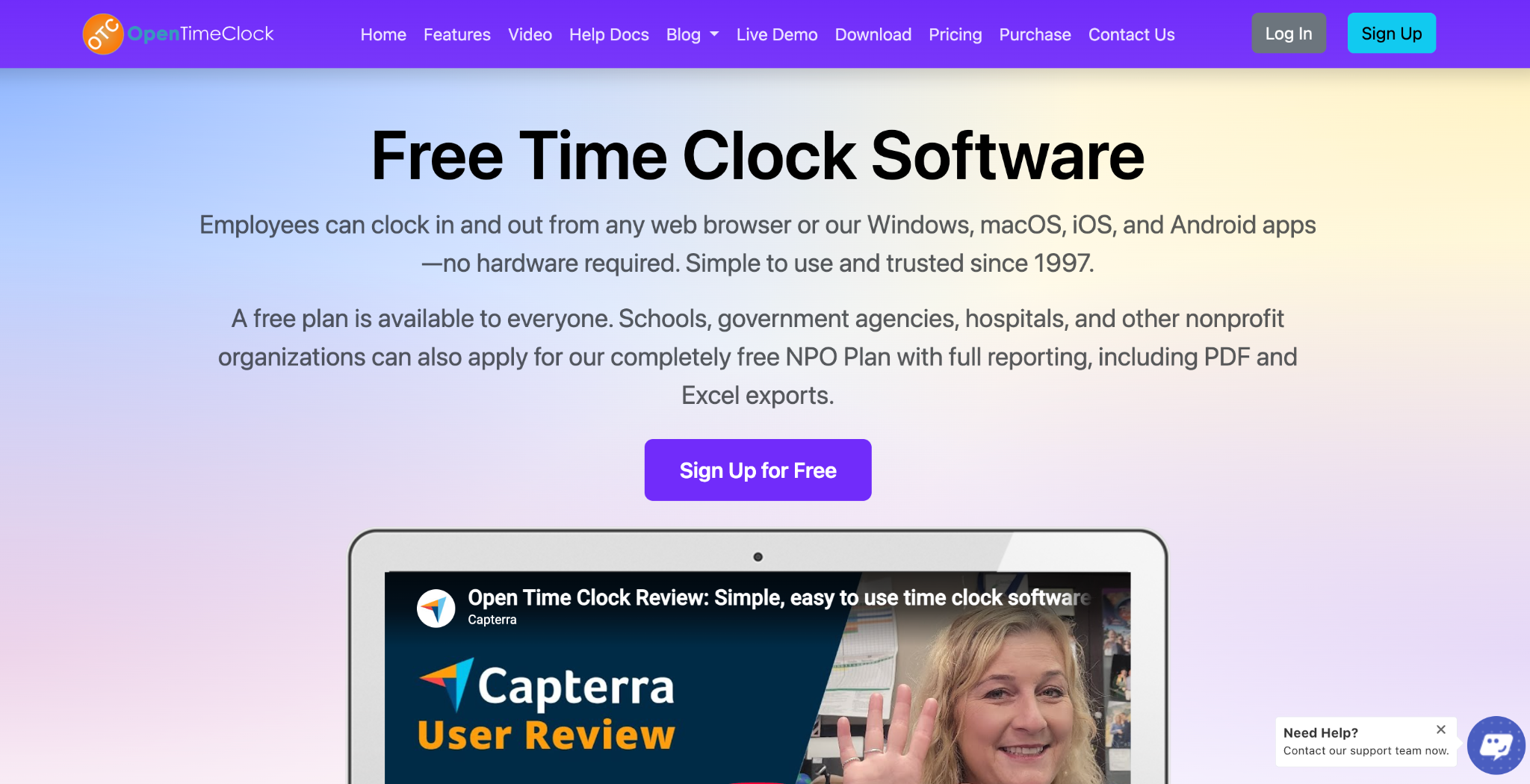
What OpenTimeClock Is and What It Focuses On
OpenTimeClock vs Factorial starts with a fundamental difference in design philosophy. While Factorial tries to cover the full HR landscape, OpenTimeClock focuses specifically on doing time and attendance tracking exceptionally well.
OpenTimeClock is built around accurate, verified clock-in. Every design decision in the platform supports the core goal of knowing precisely who was working, when, and for how long, with the verification depth to make those records defensible in any payroll dispute or compliance audit.
The platform supports facial recognition using any device camera, photo capture at every clock event, GPS location recording at mobile clock-in, PIN entry, QR code scanning, RFID card reading, and barcode scanning. All of these methods are included in the free platform with no hardware purchases required beyond a standard tablet or smartphone.
Around this core time tracking foundation, OpenTimeClock builds scheduling, PTO management, overtime calculation, real-time attendance monitoring, team messaging, and payroll export. These features are comprehensive enough for most businesses and are all available at no cost.
Time Tracking: Where the Platforms Differ Most
In the OpenTimeClock vs Factorial comparison, time tracking is where the difference is most significant and where the choice between platforms has the most practical impact.
Factorial's time tracking is functional and covers the basics. Employees clock in through a browser or mobile app. GPS can be recorded. Shifts can be assigned. Overtime is calculated. For businesses that need basic time recording alongside HR functions, this is adequate.
OpenTimeClock goes significantly deeper on verification. Facial recognition is built into the core platform, running on any standard camera without additional hardware. Every clock event captures a photo that creates a permanent visual audit trail. GPS coordinates are recorded at every mobile clock-in. These verification layers make the attendance record far more defensible than a standard digital clock-in with no identity verification.
For businesses where buddy punching is a real concern, where remote employees need GPS verification, or where attendance records need to withstand audit scrutiny, the verification depth that OpenTimeClock provides as a standard free feature is a meaningful practical advantage.
Reporting: What Each Platform Provides
Both platforms provide attendance and workforce reporting, but the depth and focus of those reports reflect each platform's priorities.
Factorial's reporting covers attendance, overtime, absence, and expense reports within an HR context. Reports are designed to give HR teams a broad view of workforce data including time and attendance alongside other HR metrics. The integration of time data with broader HR data, such as connecting absence patterns to performance review data, is a strength for businesses that use Factorial as their complete HR system.
OpenTimeClock provides more than thirty pre-built report formats focused specifically on time and attendance data. Reports cover hours by employee, overtime patterns, attendance exceptions, PTO usage, project time allocation, and payroll summaries. These reports can be filtered by employee, department, date range, and other criteria and exported in CSV, XLSX, PDF, and IIF formats.
For businesses that need detailed time and attendance reporting specifically, whether for payroll processing, compliance documentation, or operational management, OpenTimeClock's report depth in this specific area is greater than Factorial's time-focused reporting.
Employee Management Features
Factorial's strength in the OpenTimeClock vs Factorial comparison is employee management breadth. It covers the HR functions that go beyond time tracking, including employee records and document management, performance review workflows, expense reporting, and in some markets payroll processing. For businesses that want a single platform to handle multiple HR functions, Factorial provides more comprehensive employee lifecycle management than OpenTimeClock.
OpenTimeClock focuses on the workforce management functions that connect directly to time tracking. Employee profiles, scheduling, leave management, PTO balances, and payroll exports are all well-handled. Functions that go further into HR territory, such as performance reviews, expense management, and recruitment, are outside OpenTimeClock's scope.
For businesses whose primary HR software need is time and attendance rather than full HR lifecycle management, this distinction does not matter. For businesses that genuinely need integrated performance management and expense reporting alongside time tracking in a single platform, Factorial's broader scope is more relevant.
Scheduling: How Both Platforms Handle Shift Management
Both platforms include shift scheduling as part of their feature set.
Factorial's scheduling module allows managers to create shifts, assign employees, and manage availability. It integrates with the time tracking module so that employees clock in against their scheduled shifts. The interface is clean and modern, consistent with Factorial's overall design philosophy.
OpenTimeClock's shift scheduling feature supports the creation of fixed and rotating shifts, employee assignment, clock-in window restrictions, reusable weekly schedule templates, and employee self-service schedule viewing through the personal portal. The scheduling integrates directly with the attendance tracking and overtime calculation so that the planned schedule and the actual attendance are visible in the same system.
For most businesses, both platforms provide adequate scheduling functionality. The difference is that OpenTimeClock's scheduling is included in a free platform while Factorial's scheduling comes as part of a paid subscription.
PTO and Leave Management
Both platforms handle PTO and leave management, and both are competent in this area. Factorial includes PTO management with accrual tracking, leave request workflows, and absence reporting as part of its HR suite. The leave data connects to other HR functions such as payroll in markets where Factorial processes payroll.
OpenTimeClock includes comprehensive PTO management with configurable accrual rules, multiple leave types, employee self-service balance checking through the personal portal, manager approval workflows with instant notifications, and automatic balance updates on approval. PTO data is included in payroll exports so that leave taken is accurately reflected in compensation calculations.
For businesses that primarily need PTO management connected to payroll rather than connected to broader HR functions like performance management, OpenTimeClock's approach is effective and costs nothing.
Pricing: The Most Decisive Difference
The pricing difference between OpenTimeClock vs Factorial is decisive for most small and medium businesses.
Factorial operates on a per-employee monthly subscription model. Even on a basic plan, a business with twenty employees might pay one hundred dollars per month or more. For mid-tier plans that include the features most businesses actually need, costs are higher. Over three years, the cumulative subscription cost for a twenty-person team can reach several thousand dollars.
OpenTimeClock is completely free. No subscription fees, no per-employee charges, no location limits, and no feature tiers requiring upgrades. The complete platform, including facial recognition, GPS tracking, scheduling, PTO management, overtime calculation, real-time dashboard, and payroll exports, is available at zero cost.
For businesses evaluating OpenTimeClock vs Factorial primarily on value, this pricing difference is the most significant factor in the comparison. The question is whether Factorial's broader HR capabilities are worth the ongoing subscription cost for each specific business's situation.
Which Platform Should You Choose
The OpenTimeClock vs Factorial decision comes down to what your business actually needs.
Choose Factorial if your business needs a complete HR operating system that covers performance management, document management, expense reporting, and in some markets payroll processing, alongside time tracking. If you need HR breadth and are willing to pay for it, Factorial provides a modern integrated platform.
Choose OpenTimeClock if your primary need is accurate, verified time and attendance management with strong biometric verification, comprehensive reporting, reliable scheduling, and payroll exports. If you want professional-grade workforce management without ongoing subscription costs, OpenTimeClock delivers everything most businesses need at zero cost.
For the majority of small and medium businesses that primarily need to know who worked when and to pay them correctly, OpenTimeClock's focused approach delivers more practical value than Factorial's broader HR suite at a fraction of the cost.

Conclusion
OpenTimeClock vs Factorial is a comparison between depth and breadth. Factorial goes broad across HR functions at a meaningful subscription cost. OpenTimeClock goes deep on time tracking and attendance verification at zero cost.
For businesses where time and attendance accuracy is the primary need, OpenTimeClock wins the comparison decisively. For businesses that genuinely need the full HR suite that Factorial provides and are prepared to pay for it, Factorial's broader capabilities may justify the investment.
Sign up for free at OpenTimeClock and evaluate the full platform with no time limit and no credit card required.
FAQ’s
Q1. What is the main difference between OpenTimeClock vs Factorial?
In the OpenTimeClock vs Factorial comparison, the main difference is scope and cost. Factorial is a broad HR platform covering time tracking, performance management, expense reporting, and document management at a per-employee monthly subscription cost.
Q2. Does OpenTimeClock have better time tracking verification than Factorial?
Yes. OpenTimeClock provides facial recognition using any device camera, photo capture at every clock event, GPS location recording, and multiple verification fallback methods as standard free features. Factorial's time tracking is functional but does not provide the same level of biometric verification depth without additional hardware investment.
Q3. Which platform is better for reporting in the OpenTimeClock vs Factorial comparison?
For time and attendance specific reporting, OpenTimeClock provides more than thirty pre-built report formats covering hours, overtime, attendance exceptions, PTO, and project time, all exportable in multiple formats. Factorial's reporting covers broader HR metrics but is less specialized for deep time tracking analysis.
Q4. Is OpenTimeClock free while Factorial requires a subscription?
Yes. In the OpenTimeClock vs Factorial comparison, cost is one of the most significant differences. OpenTimeClock is completely free with no credit card required, no per-employee fees, and no feature tiers. Factorial operates on a per-employee monthly subscription that represents a meaningful ongoing cost for teams of any size.
Q5. Which businesses should choose OpenTimeClock over Factorial?
Businesses whose primary need is accurate, verified time and attendance management should choose OpenTimeClock. This includes most small and medium businesses in retail, restaurants, construction, healthcare, logistics, and professional services that need reliable clock-in verification, scheduling, PTO management, and payroll exports without the broader HR functions that Factorial provides.